
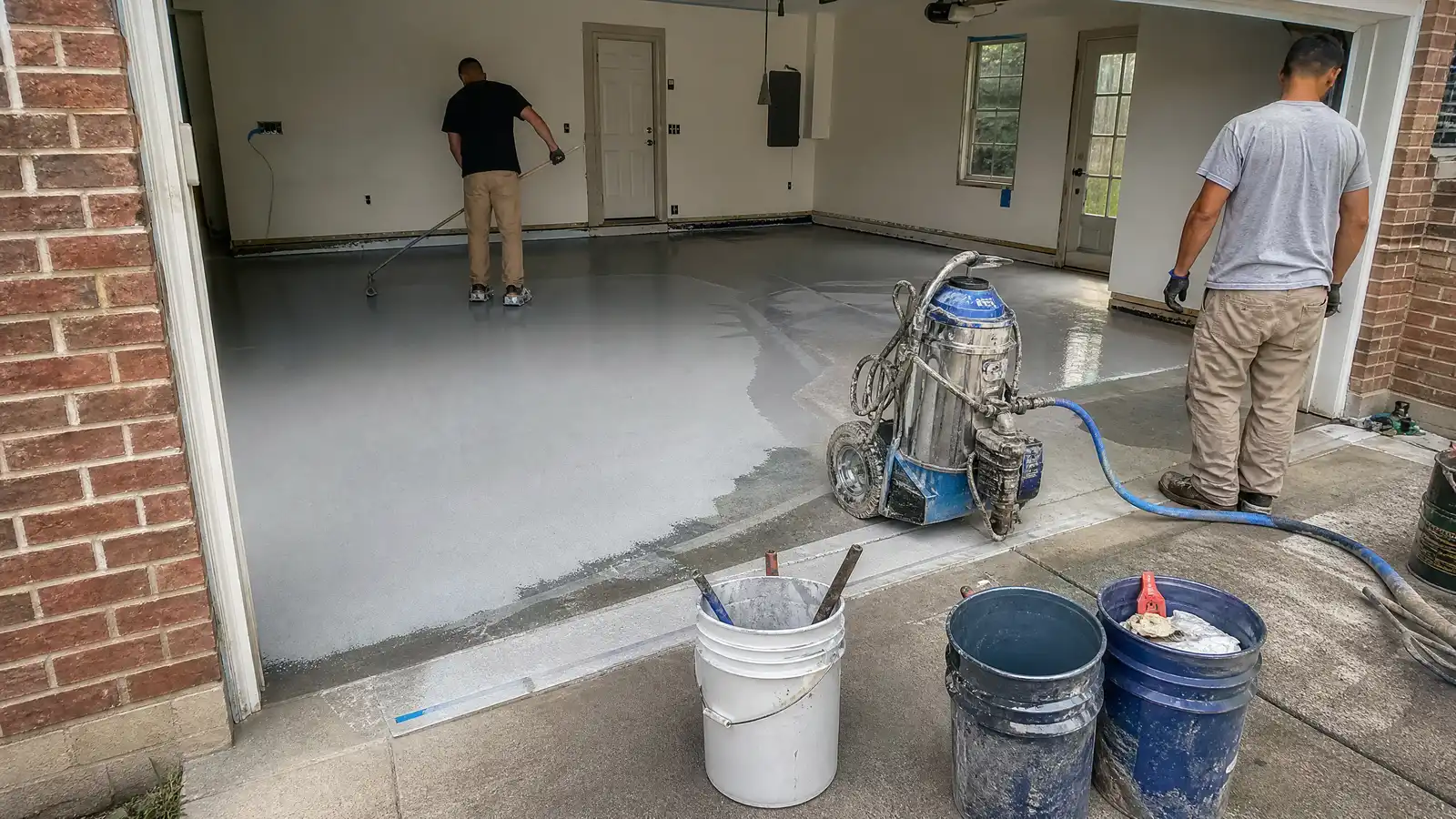
Polyaspartic Garage Floor Coating in Sumter, SC
Polyaspartic Garage Floor Coating with durable, easy-clean results for homes in Sumter County, SC. Free on-site estimate and written quote. Call for a quote.
A clean, bright garage floor is satisfying, and a floor that peels after one summer is expensive. Sumter Epoxy Floors installs a polyaspartic garage floor for homeowners across Sumter County, SC, with a free on-site estimate and a written quote before any work starts. A polyaspartic coating is a hard, glossy layer that bonds to prepared concrete and stands up to hot tires, oil, road salt residue and sun. The coating matters, but the prep underneath it matters more. This page explains how the process works, where moisture can cause trouble, and what the job costs, so you can compare quotes with confidence.

Understanding the Process
Polyaspartic is a type of polyurea. It arrives as a liquid, goes onto the concrete in thin coats, and hardens into a tough, flexible film. Most garage jobs use a base coat, a layer of decorative color flakes, and one or more clear topcoats.
Concrete is porous, so the coating has to grip the surface, not just sit on it. That grip comes from grinding, not from a quick wash. Installers describe polyaspartic coatings as UV stable and as lasting 15 to 25 years with care, though those are manufacturer and installer claims, not independent test results (Concrete Network, accessed Oct 2026).
Who Gets the Most From It
- Homeowners in Sumter, Dalzell, Shaw AFB-area neighborhoods, Mayesville, Pinewood, Rembert and Manning with a stained, dusty or flaking garage floor.
- Owners of garages with big doors that face the afternoon sun.
- Small business owners with a shop, workshop or showroom that needs a clean, easy-to-mop floor.
- Anyone who wants to use the garage again soon, since cure time is a big draw (covered below).
Polyaspartic vs. Epoxy: Which Suits a South Carolina Garage?
Both coatings protect concrete, and both can look great. They behave differently on the job.
Epoxy is thick, bonds well, and is often the more affordable option. It can yellow or turn chalky under strong sunlight, which matters if your garage door stays open or faces west. Polyaspartic is more flexible and is promoted as UV stable, so it tends to hold its clarity and color in bright light.
Many installers combine the two: an epoxy base for build and bonding, with a polyaspartic topcoat for sun and scuff resistance. Straight polyaspartic systems cost more per square foot but go in faster.
If your garage is shaded, rarely opened and on a tight budget, epoxy may be all you need. If it gets lots of light, sees daily use, or you want the floor back in service quickly, polyaspartic is worth pricing. At your estimate, we’ll tell you which makes sense for your slab, not just which costs more.
UV and Sunlight
Sumter summers are hot and humid. Average daily highs reach 87.3°F in June, 90.2°F in July and 88.5°F in August (Wikipedia, Sumter, South Carolina, accessed Oct 2026). Add a garage door that opens onto a sunny driveway, and a floor coating gets plenty of ultraviolet exposure.
UV light is what breaks down many epoxy topcoats over time, causing a yellow or amber tint. Polyaspartic coatings are described by installers as UV stable, so a clear topcoat is less likely to discolor. That is a manufacturer-side claim, so ask to see the product data sheet for whichever coating we propose.
This matters most for homeowners with a sunlit garage, a open-door workshop, a covered patio or a pool deck. Heat also affects how the coating is applied, which is why summer scheduling and slab temperature are part of the plan.
Cure Time
Polyaspartic is known for curing quickly, which is the main reason homeowners choose it. A system that might take several days with epoxy can often be finished faster, with light foot traffic returning sooner and vehicles following after the manufacturer’s stated cure window.
Fast curing also means less time for dust and insects to land in wet coating, and less time without your garage. Your exact timeline depends on the product, temperature and humidity on the day. Summer heat can shorten working time, so the crew has to move in an organized way.
We’ll give you the manufacturer’s cure guidance in writing with your quote. As a rule, wait until the product data sheet says tires are safe, even if the floor feels hard. Driving on it too early is a common way to mark a new coating.
Moisture Limits
Moisture is the main cause of coating failure, and Sumter’s humidity makes it worth taking seriously. Polyaspartic coatings should not go on a slab with a high moisture vapor emission rate, because moisture can make the coating bubble up and lift (Concrete Network, accessed Oct 2026).
Concrete is tested before coating. Two standard methods exist:
- ASTM F2170 places probes in the slab at about 40 percent of slab depth for slabs that dry from one side, or 20 percent when they dry from both sides (Wikipedia, Epoxy moisture control system, accessed Oct 2026).
- ASTM F1869, the calcium chloride test, measures only the top quarter inch of the slab, so it can miss deeper moisture (Construction Canada, accessed Oct 2026).
Typical epoxy coatings call for slab relative humidity of 75 percent or lower, but the coating maker’s data sheet sets the real limit for each product (One Stop Epoxy, accessed Oct 2026). If a slab reads too high, we’ll explain your options before any coating goes down.
Step by Step
- Free on-site estimate. We look at the slab, check for cracks, old coatings and oil stains, and measure square footage.
- Moisture check. We test the concrete and compare results with the product’s limits.
- Grinding and repair. Diamond grinding opens the surface, following the profile guidance in ICRI Guideline 310.2R. Cracks and chips are filled and leveled.
- Base coat. The color coat goes down in even passes.
- Flakes and topcoat. Decorative flakes are broadcast, then clear polyaspartic seals the surface. Texture can be added for grip, a point worth considering given OSHA 29 CFR 1910.22 on walking-working surfaces.
- Walkthrough and care notes. We review the finished floor and give you cure and cleaning instructions.
What You’ll Gain
- Hot tire resistance. A properly prepped and cured coating resists the tire pickup that can lift weaker finishes.
- Oil and chemical resistance. Spills wipe up instead of soaking into bare concrete.
- Easy cleaning. A broom and damp mop handle most dirt.
- Slip resistance. Texture additives help on wet days, and on patios and pool decks.
- A better-looking garage. Flake blends and solid colors hide small marks and dust.
Investment Guide
Price depends on square footage, slab condition, the number of coats, flake or metallic finishes, and any repair work. Here is what published sources show.
Epoxy flooring typically costs $2 to $12 per square foot installed (Angi, updated Aug 3, 2026). Professionally installed epoxy totals about $6 to $15 per square foot (Intermountain Coatings, July 2025). For a standard two-car garage, a professionally installed polyurea (polyaspartic-type) coating averages around $4,000 (The Home Depot, 2026). A Lexington, SC installer publishes bands of $1,500 to $2,500 (base), $2,500 to $4,000 (average) and $4,000 to $8,000 (high-end) (Midlands Pro Painters).
Prep adds cost: basic cleaning and etching about $1 to $2 per square foot, diamond grinding about $2 to $4, and crack repair about $3 to $5 (Intermountain Coatings, July 2025).
At the estimate visit, we measure, inspect and test, then send a written quote listing prep and coating separately. A prep-focused quote is usually worth more than a cheap number that skips grinding.
Ready to Talk About Your Floor?
We work in Sumter and nearby towns along US 15, US 76/378 and SC 441, so estimates and follow-up visits stay close to home. Ask for a free estimate and a written quote, or call (839) 600-9293 for advice. Get a Free Estimate today.
How It Works
From first call to a floor you can drive on
Free on-site estimate
We look at the floor, check for cracks, stains and old coatings, and talk through color and finish.
Written quote
You get one clear quote listing the prep, the coating system and the days the work takes.
Grind and repair
We diamond-grind the concrete, fill cracks and joints, and clean the surface before any coating goes on.
Coat and finish
We apply the coating system in stages and finish with the color and texture you chose.
Related Guides
Helpful articles to learn more about this service.
Epoxy vs Polyaspartic: Which Is Better for a South Carolina Garage?
Epoxy vs polyaspartic for a South Carolina garage: compare cost, sunlight, cure time and moisture risks before choosing Polyaspartic Garage Floor Coating.
Read guide →Polyaspartic Garage Floor Cost (2026)
Polyaspartic floor cost in Sumter, SC: see sourced price ranges, what prep adds, and how to compare quotes for a Polyaspartic Garage Floor Coating.
Read guide →Frequently Asked Questions
For a two-car garage, a professionally installed polyurea-type coating averages around $4,000 (The Home Depot, 2026). Slab condition, repairs and finish choices move that up or down. Our free estimate gives you a written figure for your exact floor.
Installers describe polyaspartic coatings as lasting 15 to 25 years with care, but those are manufacturer and installer claims, not independent test results (Concrete Network, accessed Oct 2026). Prep, moisture and use all affect real-world life.
Peeling usually traces back to poor prep or moisture, not tires. When the concrete is ground, tested and coated correctly, hot tire pickup is far less likely. Skipping prep is what causes most failures.
Yes. Moisture can make a coating bubble and lift (Concrete Network, accessed Oct 2026). Testing under ASTM F2170 or F1869 shows whether your slab is dry enough for the product we plan to use.
Usually not directly. Old paint is ground off, and cracks are repaired first, at roughly $3 to $5 per square foot (Intermountain Coatings, July 2025). We assess both at your estimate.
Ready for a floor that lasts?
Tell us about your garage, patio or shop floor. We reply with a written estimate and explain exactly how the concrete will be prepared.