
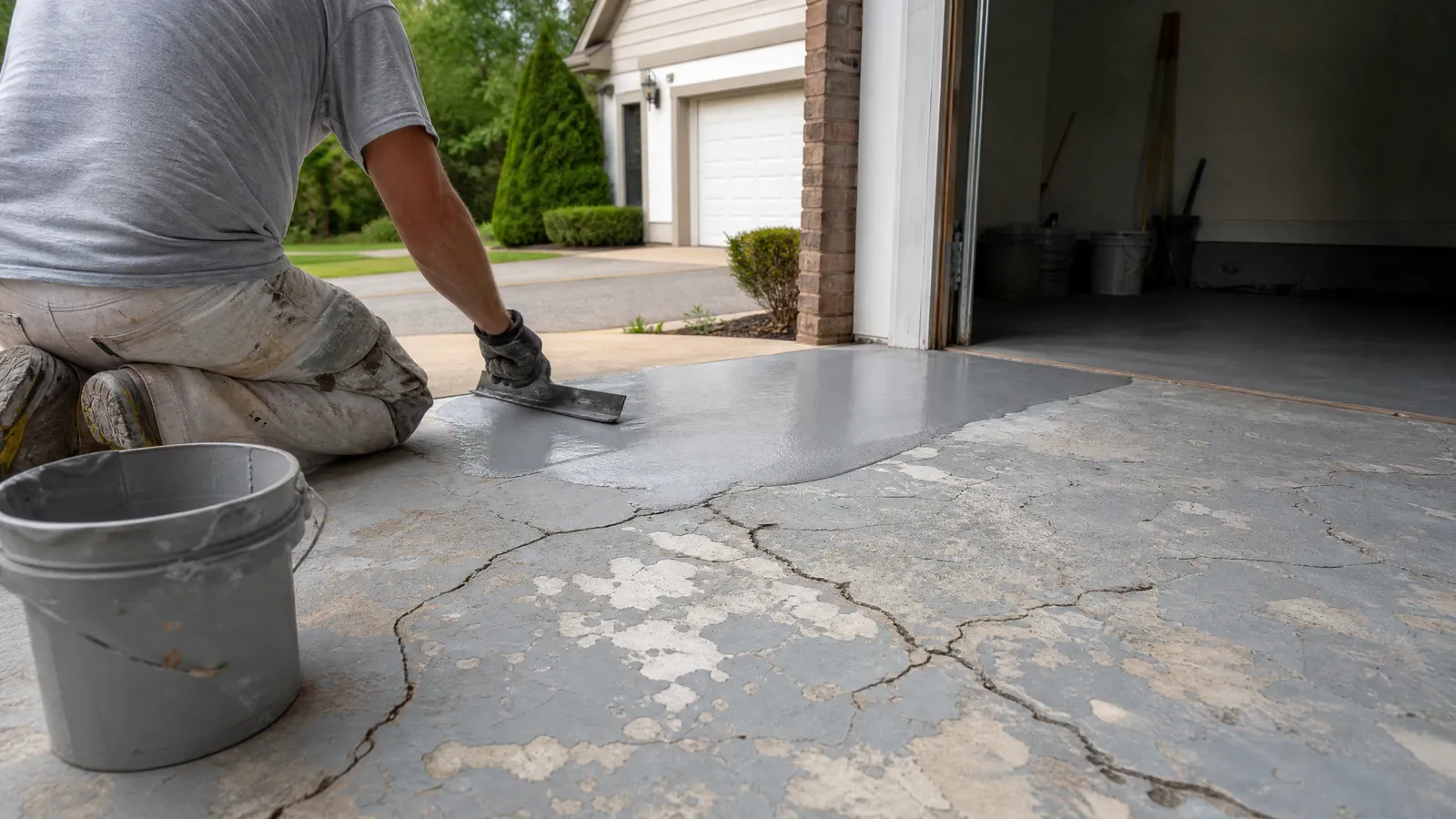
Epoxy Over Old Paint, Sealer or Cracked Concrete in Sumter, SC
Can you put epoxy over old paint, sealer or cracked concrete? Learn what to check first, plus how Epoxy Floor Repair & Removal prevents peeling in Sumter, SC.
Sometimes you can, but only when the old layer is bonded tight and the slab underneath is dry and sound. At Sumter Epoxy Floors, the question we hear most is whether epoxy over old paint will hold, or whether it will peel and waste the money. The honest answer depends on what is on the floor now, and prep decides the outcome far more than the coating itself.
When epoxy can go over existing paint
Epoxy only holds as well as the layer beneath it. If the old paint is stuck firmly to the concrete, it can sometimes be roughed up and coated. If it flakes, chalks or lifts under a scraper, the new coating will lift with it.
A simple check: press a strip of duct tape onto the paint, rub it down, and rip it off. If paint comes away with the tape, or you can chip it with a putty knife, it needs to come off. Thin garage floor paint often fails this test, especially where hot tires have sat.
Paint that passes still needs to be scuffed with a grinder or abrasive so the epoxy has something to grip. Cleaning off oil, grease and wax comes first. Sanding alone rarely does the job on glossy finishes.
If the old coating is peeling, our epoxy floor repair and removal work covers grinding it off down to bare concrete so the new floor starts clean.
Sealed concrete: the water drop test
Many slabs carry a clear sealer that blocks epoxy from soaking in. To check, sprinkle a little water on the floor. If it soaks in and darkens the concrete within a few minutes, the surface is open and can take a coating. If the water beads up, a sealer or other film is still there.
Sealed concrete usually needs diamond grinding rather than acid etching. Intermountain Coatings (July 2025) puts basic cleaning and etching at about $1 to $2 per square foot, and diamond grinding for damaged concrete at about $2 to $4 per square foot. Grinding costs more, but it opens the pores and removes most sealers in one pass.
Cracks, chips and rough patches
Cracked concrete can be coated, provided the cracks are repaired first. Hairline cracks that are not moving can be filled with a repair material, then ground flush. Wider cracks, or ones where one side sits higher than the other, point to movement in the slab. Those need a closer look, because a coating can telegraph a moving crack right back through.
Crack repair and patching adds about $3 to $5 per square foot, according to Intermountain Coatings (July 2025). That figure applies to the repaired area, so a garage with a few cracks will not be priced the same as one with a crumbling surface.
Epoxy is not a structural fix. If a slab is sinking, heaving or breaking apart, that problem needs sorting before any coating goes down.
Moisture is the check people skip
Sumter’s humid subtropical summers, with average highs of 87.3°F in June, 90.2°F in July and 88.5°F in August (Wikipedia, Sumter, South Carolina), keep a lot of moisture in the ground and in the air. Concrete slabs can pass that moisture up through the floor, and trapped vapor can push a coating off the slab.
Testing takes the guesswork out. One Stop Epoxy notes that typical epoxy coatings call for slab relative humidity of 75 percent or lower, but the coating maker’s data sheet sets the real limit for each product. The ASTM F2170 in-situ test places probes at about 40 percent of slab depth for slabs that dry from one side, according to Wikipedia’s epoxy moisture control entry. The calcium chloride test (ASTM F1869) reads only the top quarter inch of the slab, so it can miss deeper moisture (Construction Canada).
If a reading comes back high, there are moisture-control primers made for that situation. That is a conversation worth having before anyone mixes a batch.
Key takeaways
- Epoxy over old paint works only when the paint is firmly bonded and properly scuffed.
- A water drop test shows quickly whether a sealer is blocking the surface.
- Cracks should be repaired and ground flush first, and moving cracks need a closer look.
- Moisture testing matters in Sumter’s humid summers and prevents many peeling failures.
- A written quote should spell out the prep, so you know what you are paying for.
Get a clear answer for your floor
Not sure what is under your coating? Request a Get a Free Estimate visit. We will check the paint, sealer, cracks and moisture on site, explain each prep step, and give you a written quote. You can also call (839) 600-9293.
Frequently Asked Questions
Rolling epoxy straight over old paint is a gamble. The paint must be tightly bonded, clean and scuffed first. If it peels with tape or a scraper, it has to come off. Skipping those steps is the usual reason a new coating lifts within a year or two.
Epoxy bonds to cracked concrete once the cracks are cleaned and filled, and the surface is ground level. It will not stop a crack that keeps moving. Stable hairline cracks are usually fine, while widening or uneven cracks should be inspected before any coating goes on.
Yes. A slab can look and feel dry while still passing vapor upward. Testing is the only reliable way to know. Per One Stop Epoxy, the coating maker's data sheet sets the real moisture limit for each product, so testing tells you whether your slab is within it.
Ready for a floor that lasts?
Tell us about your garage, patio or shop floor. We reply with a written estimate and explain exactly how the concrete will be prepared.